
AI Voice Agents
EU AI Act Is Now Live: What Voice AI & AI Agent Teams Need to Know in 2026
The EU AI Act's new transparency requirements took effect on 2 August 2026, changing how businesses deploy customer-facing AI. Here's what the new rules mean for voice AI agents, automated customer interactions and enterprise AI deployments.
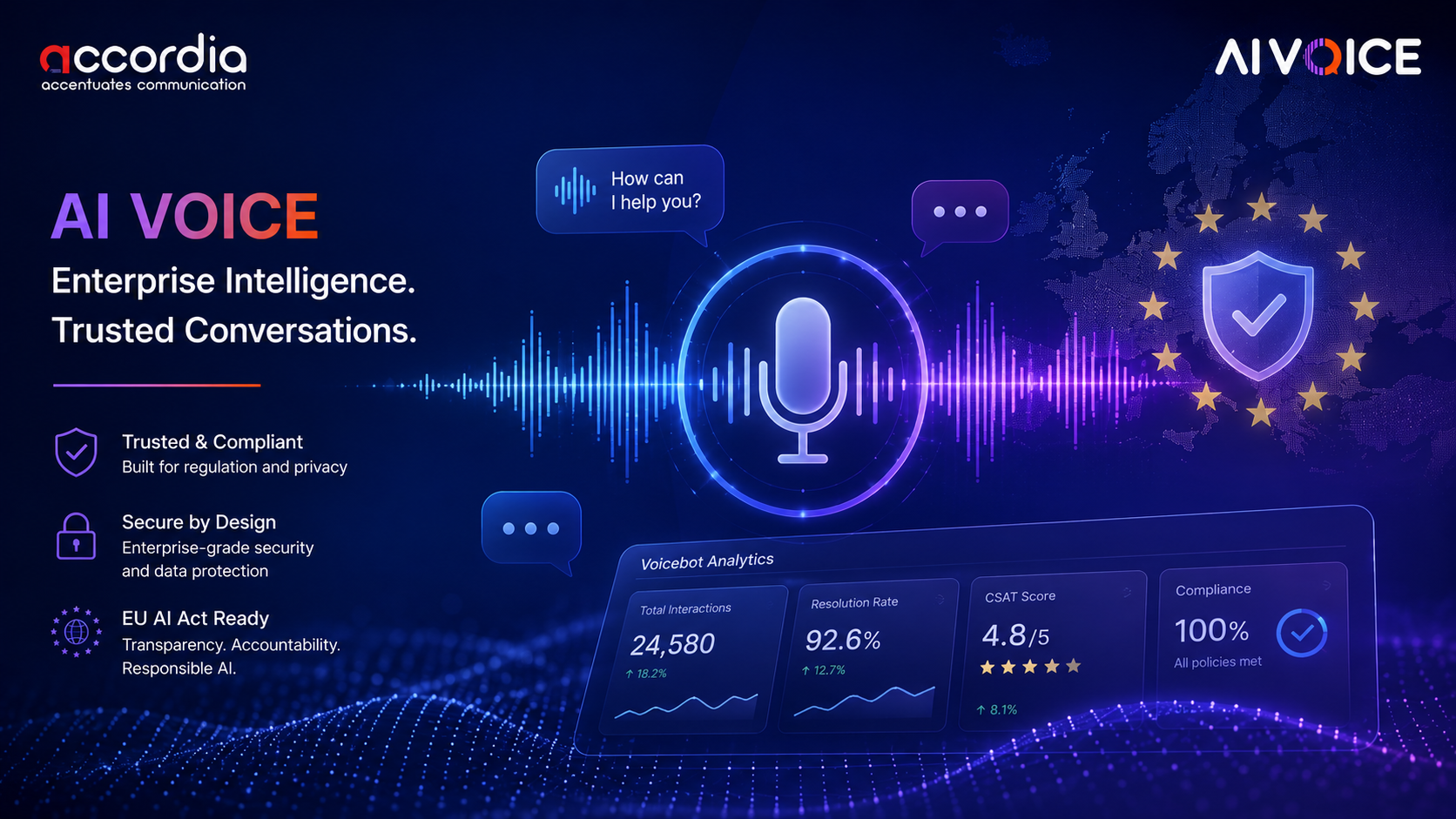
The EU AI Act Just Changed the Rules for Customer-Facing AI
August 2026 marks an important milestone for artificial intelligence.
From 2 August 2026, transparency obligations under Article 50 of the European Union's AI Act began applying to certain AI systems.
For companies deploying AI voice agents, conversational AI and other customer-facing AI systems, this introduces an important principle:
People should know when they are interacting with AI.
For enterprises already deploying AI agents across customer service, sales, appointment booking, collections and contact centres, AI governance can no longer be treated as something to consider only after deployment.
It needs to become part of the architecture.
What Changed on 2 August 2026?
Article 50 of the EU AI Act introduces transparency requirements for several categories of AI systems.
One particularly relevant requirement for conversational AI concerns systems that interact directly with people.
When applicable, AI systems designed for genuine two-way interaction must be designed so that users are informed that they are interacting with an AI system, unless that fact is already obvious from the circumstances.
This has clear implications for technologies such as:
AI voice agents
AI customer-service agents
Conversational AI
AI-powered contact centres
Virtual assistants
Automated sales agents
AI appointment-booking systems
For businesses operating internationally, the important lesson is broader than one regulation.
As AI becomes capable of performing more real-world actions, transparency, governance and traceability are becoming product requirements.
What Does This Mean for Voice AI?
Consider a typical enterprise phone call.
A customer calls a company's support number.
Instead of waiting for a human agent, an AI voice agent answers immediately.
The agent can understand the customer's request, access approved business information, check an appointment, create a support ticket or transfer the customer to the appropriate human agent.
Technically, this can create a significantly better customer experience.
But the interaction should not depend on making the caller believe that the AI is human.
A simple disclosure at the beginning of the interaction can make the nature of the experience clear.
For example:
"Hello, I'm the AI assistant for [Company]. How can I help you today?"
This small design decision establishes transparency from the beginning of the conversation without adding unnecessary friction.
Transparency Should Not Make Voice AI Less Natural
There is sometimes an assumption that identifying an AI agent will make conversations feel robotic.
It doesn't have to.
Modern voice AI can still provide natural turn-taking, understand interruptions, maintain context and respond conversationally while being transparent about being AI.
The objective should not be to make an AI agent indistinguishable from a human employee.
The objective should be to make it useful, fast, trustworthy and clear about what it is.
That distinction will become increasingly important as AI-generated voices become more realistic.
AI Voice Security Is Becoming Just as Important
Transparency is only one part of responsible enterprise AI.
Today's voice agents are rapidly moving beyond answering FAQs.
They can increasingly perform actions.
A voice agent might:
retrieve customer information,
update CRM records,
schedule an appointment,
create a ticket,
trigger a workflow,
transfer a call,
send information to another system, or
interact with external APIs.
Once an AI system can perform these actions, it effectively has permissions inside the enterprise environment.
That means organisations should think about AI-agent security in much the same way they think about employee access.
Not every agent should be allowed to perform every action.
Give AI Agents the Minimum Permissions They Need
One useful architecture principle is least privilege.
An AI voice agent should only receive access to the tools and information required for its specific job.
For example, an appointment-booking agent may need permission to:
check appointment availability,
retrieve an existing booking,
create or reschedule an appointment.
It probably does not need unrestricted access to the company's entire CRM or customer database.
Higher-risk actions may also require additional verification or human approval.
The more capable AI agents become, the more important these permission boundaries become.
Every Important AI Action Should Be Traceable
Enterprise AI systems should also create an audit trail.
When an AI agent performs an important action, organisations should be able to understand what happened.
Useful audit information can include:
when the interaction occurred,
which AI agent handled it,
what action was requested,
which business tool was called,
whether the action succeeded,
what information changed, and
whether the interaction was transferred to a human.
This becomes especially important in industries such as banking, insurance, telecommunications, automotive services, healthcare administration and government services.
AI observability isn't only useful for compliance.
It also helps engineering and operations teams identify where an agent fails and continuously improve its performance.
What About AI-Generated and Synthetic Voices?
The AI Act also contains transparency requirements relating to AI-generated or manipulated content.
This matters because synthetic speech technology has advanced dramatically.
AI can now generate highly realistic voices, including voices that resemble real individuals.
For enterprise voice applications, organisations should therefore establish clear governance around voice creation and usage.
Questions worth asking include:
Is the voice fully synthetic?
Is it based on a real person's voice?
Was permission obtained for any cloned voice?
Could callers incorrectly believe they are speaking with a particular real person?
Is the organisation's use of the voice clearly documented?
As voice synthesis improves, responsible voice governance becomes increasingly important.
AI Agents Are Moving From Conversation to Action
The larger transformation happening in 2026 goes beyond regulation.
The first generation of conversational AI primarily answered questions.
The next generation performs tasks.
A modern voice agent can potentially combine:
Listen → Understand → Reason → Retrieve → Act → Confirm
For example, imagine a customer saying:
"I need to move my service appointment from Friday to Monday morning."
A capable enterprise voice agent could:
understand the request,
identify the customer,
retrieve the current appointment,
check Monday availability,
offer available slots,
update the booking after confirmation,
record the action, and
send a confirmation.
That is no longer simply a chatbot connected to a phone line.
It is an AI agent participating in a business workflow.
The Enterprise Voice AI Architecture Is Changing
As AI agents become more capable, enterprise architecture is evolving around several layers.
1. Conversation Layer
Handles natural speech, interruptions, multilingual conversations and turn-taking.
2. Intelligence Layer
Understands intent, maintains context and determines what should happen next.
3. Knowledge Layer
Connects the AI agent to approved enterprise information and knowledge bases.
4. Action Layer
Allows controlled access to APIs, CRM systems, ticketing systems, calendars and other enterprise tools.
5. Governance Layer
Controls authentication, permissions, logging, monitoring, escalation and policy enforcement.
The fifth layer is becoming just as important as the intelligence itself.
Human Handoff Still Matters
AI agents should not be designed around the assumption that every conversation must be automated.
Some conversations require humans.
The important question is whether the AI knows when to escalate.
Examples may include:
highly sensitive customer situations,
requests outside the agent's authorised scope,
repeated misunderstanding,
security verification failures,
unusual exceptions, or
explicit requests to speak with a person.
A strong AI-to-human handoff should also preserve context.
Customers should not have to repeat the entire conversation after being transferred.
What Enterprises Should Do Now
Organisations deploying voice AI should review their systems across four areas.
Transparency
Make sure customers can clearly understand when they are interacting with AI where required.
Permissions
Define exactly which systems and actions each AI agent is authorised to access.
Auditability
Maintain useful logs of conversations, tool usage and important automated actions.
Human escalation
Define when and how an AI agent transfers control to a human employee.
These principles improve more than compliance.
They improve reliability.
Responsible AI Can Become a Competitive Advantage
AI regulation is sometimes viewed purely as a restriction.
For enterprise voice AI, it can also push the industry toward better products.
Customers are more likely to trust AI systems when they understand what they are interacting with and when organisations can demonstrate how those systems operate.
The companies that succeed with AI agents will therefore not necessarily be those deploying the most automation.
They will be those that combine automation with trust, governance, security and measurable business outcomes.
The Future of Voice AI Is Trusted Automation
Voice AI is entering a new phase.
The question is no longer simply:
"Can AI have a natural phone conversation?"
Increasingly, the question is:
"Can an AI agent safely complete a real business task?"
As AI agents gain access to enterprise systems and become capable of taking action, transparency and governance must evolve alongside intelligence.
The EU AI Act's transparency requirements are another signal of that transition.
The future of enterprise voice AI will not be defined only by how human an AI agent sounds.
It will be defined by how reliably, securely and transparently it can work.
Frequently asked questions
Does the EU AI Act require AI voice agents to tell callers they are speaking with AI?
For AI systems covered by Article 50 that interact directly with people, providers must design the system so users are informed that they are interacting with AI, unless this is already obvious from the context. The transparency requirements apply from 2 August 2026.
When did the EU AI Act transparency rules take effect?
Article 50 transparency obligations began applying on 2 August 2026. The European Commission states that providers and deployers covered by the provision must comply from that date, subject to specific exceptions and limited transitional arrangements for certain AI-generated-content marking requirements.
Does every AI voice system automatically fall under the same EU AI Act requirements?
No. The exact obligations depend on how the AI system is designed, used and classified under the AI Act. Article 50 contains specific transparency requirements and exceptions, so organisations should assess their individual use case rather than assume every voice AI deployment is treated identically.
What should an AI voice agent say at the beginning of a call?
A simple disclosure such as “Hello, I’m the AI assistant for [Company]” can clearly tell the caller that the interaction is being handled by AI. The appropriate wording and implementation should match the organisation's use case and applicable regulatory requirements.
See it on one of your own call flows
Bring one workflow. We will configure it, validate it with controlled test calls, and show you the whole system around it.